One Robotics Supply Group

HOME / CAPABILITIES / PARTS & COMPONENTS / Robot Joints

Robot Joints

Robot joints are the mechanical and electromechanical connection points that allow a robotic system to move with controlled rotation, positioning, force and repeatability. Modern joint modules can combine motors, gearing, bearings, encoders, sensors and control electronics into compact assemblies.

One Robotics Supply Group is developing commercial capabilities to help organizations evaluate joint requirements, sourcing options and integration considerations for commercial robotic systems.

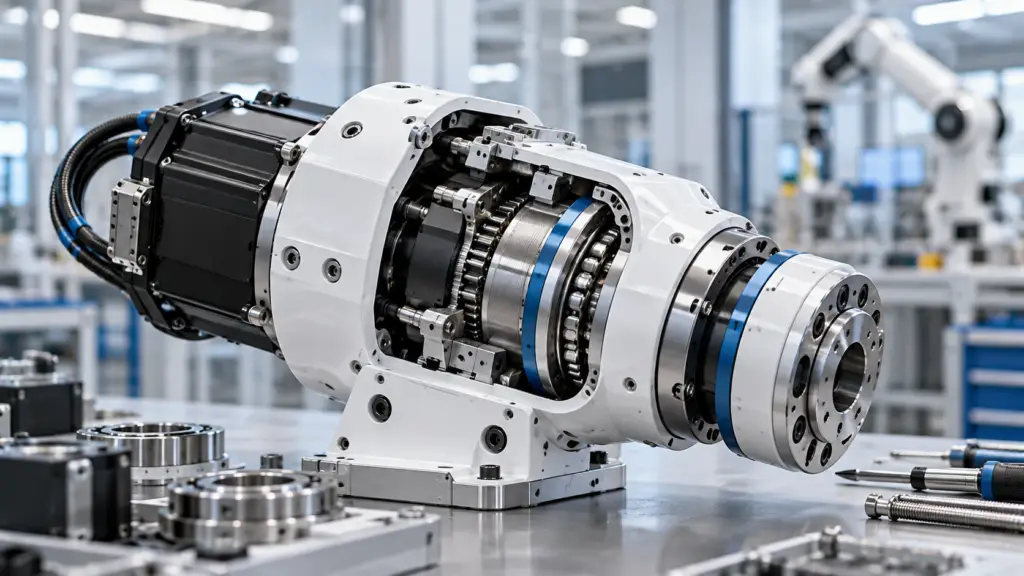
Integrated robot joint assembly for advanced robotics

UNDERSTANDING ROBOT JOINTS

What are robot joints?

A robot joint connects two rigid links and allows controlled motion between them. Depending on the robot architecture, a joint may provide rotary movement, linear movement or a combination of motion and compliance. Joints define much of a robot's usable range of motion and directly influence how the machine reaches, lifts, positions and interacts with its environment.

In advanced systems, the joint is often more than a simple mechanical pivot. An integrated joint can package the motor, transmission, bearings, encoder, brake, sensors and local electronics into a single module. This approach can reduce packaging complexity while making torque density, thermal management, backlash, serviceability and control performance especially important selection factors.

JOINT ARCHITECTURE

Core Elements of an Integrated Robot Joint

Motor and actuation

The motor provides the driving force for the joint. Motor size, torque output, speed range and efficiency must match the expected load and duty cycle.

Gear reduction and transmission

Gearboxes or other transmission mechanisms can multiply torque and shape the speed profile of a joint. Reduction ratio, backlash, stiffness and efficiency affect precision and dynamic response.

Bearings and structural support

Bearings carry radial and axial loads while supporting smooth joint rotation. Their capacity and arrangement influence stiffness, life and packaging.

Position and torque feedback

Encoders and force or torque sensing provide the control system with information about joint position, speed and load. Feedback is essential for precise closed-loop control.

Control electronics

Motor drives and local control electronics regulate current, velocity and position. Integrated electronics can reduce wiring but also introduce thermal and service considerations.

PRACTICAL EVALUATION

Key Robot Joint Selection Factors

Torque and payload

Joint torque must support the robot's payload, link mass, acceleration and expected external forces across the operating envelope.

Range of motion

The required angular travel or linear stroke should match the task without creating avoidable mechanical interference.

Backlash and precision

Low backlash and strong repeatability matter where the robot must place tools, parts or end effectors accurately.

Size, mass and torque density

Compact high-torque joints are especially important in humanoid robots, mobile manipulators and systems where mass must be carried by upstream joints.

Thermal performance

Continuous motion can generate significant heat. Cooling, duty cycle and derating should be considered alongside peak performance.

Serviceability and lifecycle

Replacement strategy, connector access, spare availability and maintenance requirements affect long-term operating cost.

ROBOTICS APPLICATIONS

Where Robot Joints Fit in Robotics

Robot joints are used throughout articulated arms, collaborative robots, humanoid robots, inspection systems, mobile manipulators and other machines that require controlled multi-axis movement. In humanoid systems, joint modules may be distributed across the shoulders, elbows, wrists, hips, knees, ankles and torso, while industrial arms use coordinated joints to position tools and payloads through a defined workspace.

SOURCING & PROCUREMENT

Sourcing and Procurement for Robot Joints

Sourcing robot joints requires more than matching a torque number. Buyers may need to compare mechanical interfaces, control protocols, encoder compatibility, voltage, thermal limits, lead times, manufacturing capacity and long-term availability. As its capabilities develop, ORSG welcomes discussions about how it may support the commercial sourcing process by helping organizations organize requirements, evaluate supplier options and connect component decisions to the broader deployment plan.

Discuss Your Requirements

FROM COMPONENT TO SYSTEM

Integration and Lifecycle Considerations

Joint performance depends on the surrounding robotic architecture. Motors, controllers, sensors, power systems, structural links and software must work together as a coordinated system. During integration, engineering teams should confirm communication interfaces, calibration requirements, cable routing, safety behavior, thermal limits and maintenance access rather than evaluating the joint in isolation.

WHO THIS IS FOR

Who This Page Is For

This page is intended for robot manufacturers, OEMs, systems integrators, engineering organizations, industrial automation teams, procurement professionals and companies evaluating or deploying advanced robotic systems.

FREQUENTLY ASKED QUESTIONS

Frequently Asked Questions About Robot Joints

What is a robot joint?

A robot joint is the connection between robot links that permits controlled motion. Depending on the design, it may provide rotation, linear movement or compliant motion while carrying structural and dynamic loads.

What is an integrated robot joint?

An integrated robot joint combines several functions such as a motor, gearbox, bearings, encoder, sensors and control electronics in one compact module.

How are robot joints different from actuators?

An actuator produces motion or force. A robot joint is the larger mechanical or electromechanical assembly where that actuation is translated into controlled movement between robot links.

What matters when selecting a robot joint?

Common considerations include torque, speed, range of motion, backlash, stiffness, size, mass, thermal performance, sensing, control compatibility and lifecycle support.

Why are compact joints important in humanoid robotics?

Humanoid robots distribute many joints throughout the body. Lower mass and higher torque density can reduce the load carried by adjacent joints and improve overall mobility and efficiency.

Can ORSG support robot joint sourcing?

As its capabilities develop, ORSG welcomes discussions about how it may support organizations evaluating robotics parts and components by helping define sourcing requirements, assess commercial options and connect component decisions with integration and deployment needs.

START A CONVERSATION

Evaluating Robot Joint Systems?

Share your technical, sourcing and deployment requirements. One Robotics Supply Group welcomes conversations as we develop commercial relationships and capabilities across the robotics ecosystem.