One Robotics Supply Group

APPLICATIONS / MACHINE TENDING

Machine Tending Robotics

Machine tending is a common automation target because operators often repeat the same sequence around production equipment: present a part, load it, start or monitor a cycle, remove the part, and move it to the next step. Robotics may help support these workflows when the process is sufficiently consistent and the equipment can be integrated safely.

One Robotics Supply Group is developing relationships and commercial infrastructure across the robotics ecosystem to help organizations evaluate sourcing, deployment, components, integration, and long-term support around practical robotics applications.
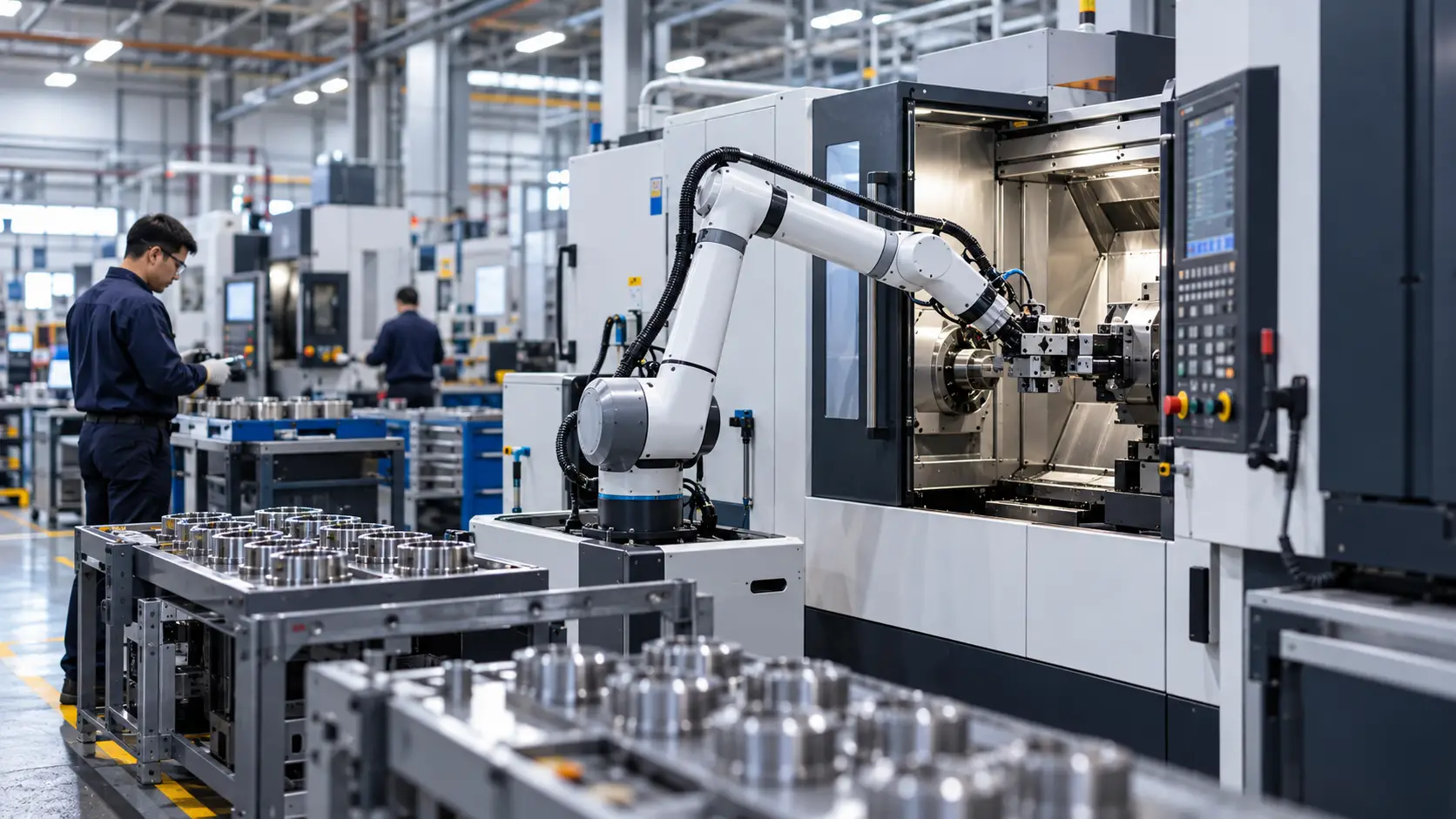

Industrial robotic arm performing automated CNC machine tending on a modern manufacturing floor with operators, tooling, and production equipment

APPLICATION OVERVIEW

Where machine tending robotics can create operational value.

A useful starting point is the sequence around each machine: how parts are presented, loaded, secured, processed and removed. Organizations can then assess which steps are repeatable, which interfaces need integration and how operators will handle exceptions.

COMMON WORKFLOWS

Where organizations may evaluate machine tending robotics.

WORKFLOW 01

Loading Equipment

Robotics may present blanks, components, trays, or other inputs to machining and production equipment.

WORKFLOW 02

Unloading Finished Parts

Robotic systems may remove completed parts and place them into racks, trays, conveyors, or downstream processes.

WORKFLOW 03

CNC Support

Manufacturers may evaluate robotic tending around CNC mills, lathes, and related equipment where cycles and workholding are repeatable.

WORKFLOW 04

Press & Forming Support

Selected applications may use robotics to load or unload presses, forming equipment, or other machinery when safety requirements are satisfied.

WORKFLOW 05

Part Presentation

Robotics may orient and position parts consistently for machines, inspection stations, or subsequent processes.

WORKFLOW 06

Cycle Monitoring

Sensors, machine vision, and connected systems may support basic monitoring of machine status, part presence, and process completion.

DEPLOYMENT

The application needs to work inside the real operation.

Successful machine tending depends on more than robot reach. Work holding, part presentation, cycle times, guarding, interlocks, machine communications, end-of-arm tooling, maintenance, and exception handling all need to be considered.

Organizations should evaluate the complete operating environment, not just a vendor demonstration. Integration, safety, service availability, maintenance, spare parts, uptime expectations, and total cost of ownership can determine whether a deployment is sustainable.

EMERGING HUMANOID SYSTEMS

Where humanoid systems may fit into this application.

Humanoid systems could eventually support machine-tending workflows in facilities built around human operators, particularly where equipment controls, doors, trays, and workstations are difficult to redesign. Current evaluations should focus on reliability, precision, cycle time, dexterity, safety, and whether a humanoid platform actually offers an advantage over a fixed arm or collaborative robot.

EVALUATION

Questions to answer before selecting a robotic system.

01

What exact task or operational problem is being addressed?

02

How repetitive, predictable, or variable is the workflow?

03

What payload, reach, mobility, dexterity, sensing, or precision is required?

04

How will the robot interact with employees, equipment, and existing systems?

05

What safety requirements and operating constraints apply?

06

What uptime, cycle time, or service level is actually required?

07

What maintenance, spare parts, software support, and service are available?

08

What is the realistic total cost of ownership?

09

How will exceptions and failures be handled?

10

Can the system scale to additional workflows, shifts, or locations?

ONE ROBOTICS SUPPLY GROUP

Building commercial infrastructure for the robotics economy.

One Robotics Supply Group is developing specialized businesses, relationships, and resources across the commercial robotics ecosystem. Our focus extends beyond individual robotic platforms to the broader infrastructure organizations may need to evaluate, source, deploy, and support robotics over time.

SOURCE

Robotics manufacturers, platforms, equipment, and supplier relationships.

Two professionals discussing a robotics component with humanoid and industrial robots in the background.

EQUIP

Parts, accessories, components, and supporting technologies.

Precision robotics components on a workbench with a humanoid robot and industrial robotic arm in a bright facility.

DEPLOY

Integration relationships, deployment planning, and operational considerations.

Humanoid robot beside a conveyor with packaged goods and an industrial robotic arm in a bright warehouse.

UNDERSTAND

Research, market intelligence, and emerging industry developments.

Humanoid robot beside a precision actuator and laptop in a bright robotics showroom.
Explore What We Do

START A CONVERSATION

Evaluating machine tending robotics for your operation?

Whether you are defining a workflow, researching available systems, comparing robotics platforms, exploring sourcing opportunities, or planning a future deployment, One Robotics Supply Group welcomes conversations with organizations preparing for commercial robotics adoption.