One Robotics Supply Group

HOME / CAPABILITIES / PARTS & COMPONENTS / Robotics Sensors

Robotics Sensors

Robotics sensors provide the measurements that allow a robot to understand its own state and respond to the surrounding environment. Position, force, proximity, inertial, tactile and environmental sensing can all contribute to closed-loop control, perception and safer operation.

One Robotics Supply Group is developing commercial capabilities to help organizations evaluate sensor requirements, sourcing options and integration considerations across commercial robotic systems.

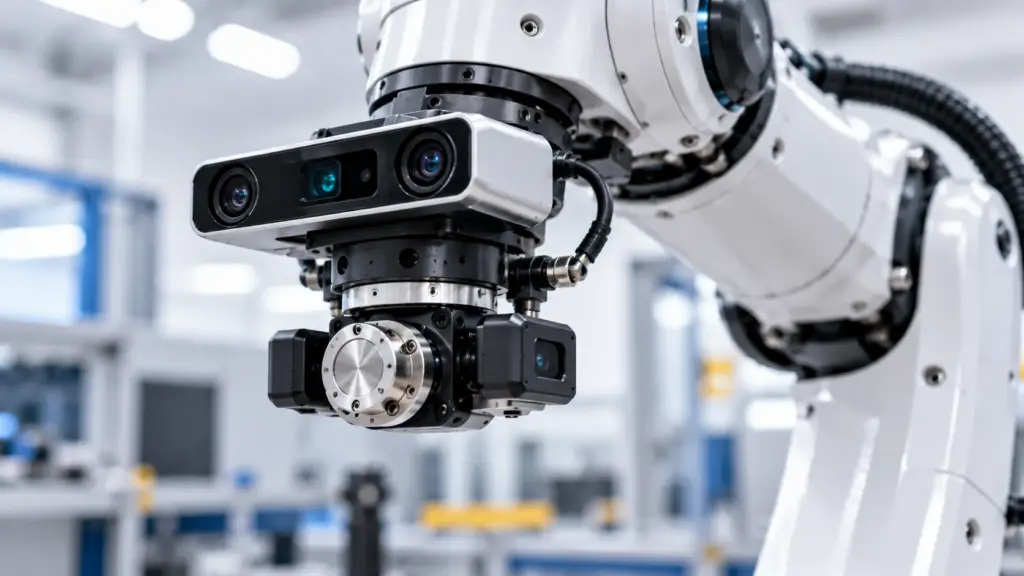
Robotics sensor array for perception and control

UNDERSTANDING ROBOTIC SENSING

What Are Robotics Sensors?

Robotics sensors convert physical conditions into data that a robot can use for control or decision-making. Some sensors measure the robot itself, such as joint position, motor current, speed or orientation. Others observe the external environment, such as distance, contact, light, temperature or the presence of nearby objects.

A modern robot rarely depends on a single sensor. Reliable operation often comes from combining multiple measurements and using software to interpret them together. This makes sensing architecture an important systems decision involving accuracy, update rate, environmental conditions, communications, calibration and computing requirements.

SENSOR TECHNOLOGIES

Common Sensor Categories in Robotics

Position and motion sensing

Encoders, inertial sensors and related devices measure joint position, speed, orientation or movement for feedback control and localization.

Force and torque sensing

Force and torque measurements help robots regulate contact, detect loads and perform controlled interaction during manipulation or assembly.

Proximity and distance sensing

Distance sensors help detect nearby objects, support obstacle avoidance and provide simple environmental awareness.

Tactile and contact sensing

Tactile sensors can measure contact location, pressure, force or slip at grippers, hands or robot surfaces.

Environmental sensing

Temperature, pressure, gas, vibration and other sensors can support specialized inspection and operating requirements.

Perception sensors

Cameras, depth sensors and LiDAR provide richer environmental data for object recognition, navigation, mapping and scene understanding.

PRACTICAL EVALUATION

Key Robotics Sensor Selection Factors

Measurement range and accuracy

The sensor must cover the expected operating range while providing enough resolution and accuracy for the control or perception task.

Update rate and latency

Fast-moving control loops may require high-rate measurements with predictable latency.

Environment

Lighting, dust, vibration, temperature, moisture, reflective surfaces and electromagnetic conditions can all influence sensor performance.

Interface and synchronization

Communication protocols, timestamps and synchronization matter when multiple sensors must be fused into a common system.

Calibration

Sensors may require initial and ongoing calibration to maintain useful measurements.

Reliability and lifecycle

Replacement availability, connector robustness and long-term support should be considered for production deployments.

ROBOTICS APPLICATIONS

Where Robotics Sensors Fit in Robotics

Robotics sensors support joint control, manipulation, machine tending, inspection, mobile navigation, collision avoidance, picking, force-controlled assembly, humanoid balance and other applications. In autonomous systems, sensor data often becomes the foundation for perception, localization and planning, while industrial robots use sensing to improve feedback, process verification and interaction with changing conditions.

SOURCING & PROCUREMENT

Sourcing and Procurement for Robotics Sensors

Sensor sourcing should start with the measurement problem. Buyers need to define the required range, accuracy, update rate, operating environment, communication interface and integration constraints before comparing components. As its capabilities develop, ORSG welcomes discussions about how it may help organizations organize these requirements and evaluate sourcing options as part of the wider robotics component and deployment strategy.

Discuss Your Requirements

FROM COMPONENT TO SYSTEM

Integration and Lifecycle Considerations

Sensor integration includes mechanical placement, electrical connections, communications, calibration and software interpretation. Multiple sensors may need consistent timestamps and coordinate frames so the robot can combine measurements correctly. Teams should also plan for diagnostics and failure behavior, because a sensor that is inaccurate, blocked or disconnected can affect the performance of the entire robotic system.

WHO THIS IS FOR

Who This Page Is For

This page is intended for robot manufacturers, OEMs, systems integrators, engineering organizations, industrial automation teams, procurement professionals and companies evaluating or deploying advanced robotic systems.

FREQUENTLY ASKED QUESTIONS

Frequently Asked Questions About Robotics Sensors

What are robotics sensors?

Robotics sensors are devices that measure the robot's internal state or surrounding environment and provide data for control, perception and decision-making.

What types of sensors are used in robots?

Robots may use position, force, torque, inertial, proximity, tactile, temperature, camera, depth and LiDAR sensing depending on the application.

What is the difference between internal and external robot sensing?

Internal sensing measures the robot itself, such as joint angle or motor state. External sensing measures the environment, such as distance, contact or visual information.

Why is sensor fusion used in robotics?

Combining multiple sensors can provide a more complete and robust estimate of the robot's state or environment than relying on one measurement source alone.

What should buyers consider when sourcing robotics sensors?

Important factors include measurement range, accuracy, update rate, latency, environmental rating, interface, calibration and lifecycle availability.

Can ORSG support robotics sensor sourcing?

As its capabilities develop, ORSG welcomes discussions about how it may support component evaluation and sourcing by helping organizations organize sensing requirements and connect component decisions with integration and deployment needs.

START A CONVERSATION

Building a Robotics Sensing Stack?

Share your technical, sourcing and deployment requirements. One Robotics Supply Group welcomes conversations as we develop commercial relationships and capabilities across the robotics ecosystem.