
One Robotics Supply Group

INDUSTRIES / AGRICULTURE

Robotics for Agriculture

Agriculture is moving beyond guidance and large autonomous machinery toward more precise robotic systems that can support monitoring, movement, treatment, handling, and selected field or facility tasks.

One Robotics Supply Group is building relationships and commercial infrastructure across the robotics ecosystem to help organizations evaluate, source, deploy, and support emerging robotic technologies.
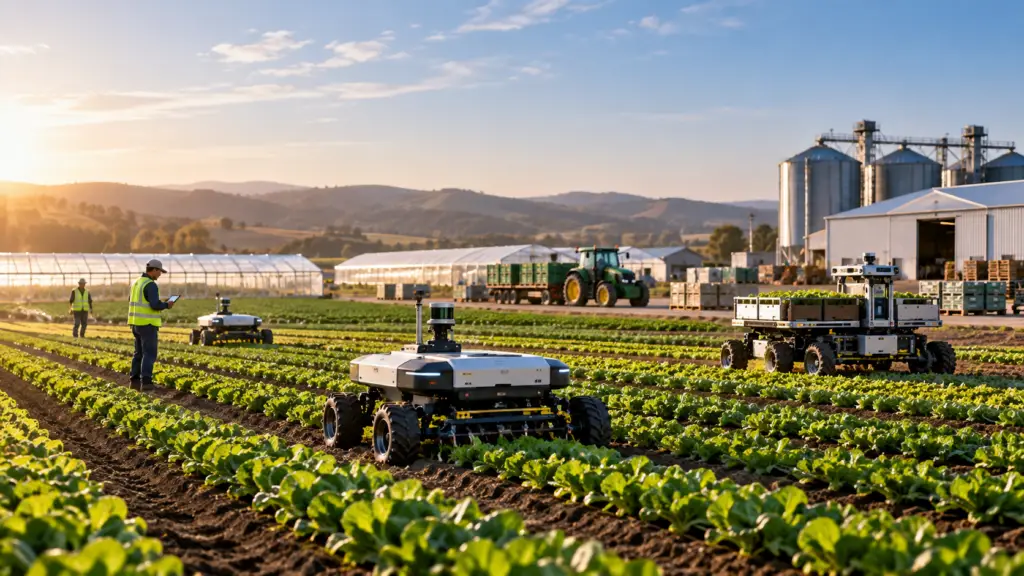

Autonomous farm robots operate across crop rows alongside workers and agricultural equipment, demonstrating agricultural robotics and automation in a modern commercial farming environment

AGRICULTURAL ROBOTICS

Robotics is expanding from autonomous machinery into more precise agricultural workflows.

Agriculture already relies on advanced machinery, GPS guidance, sensing, and automation. The next stage is adding more autonomous and task-specific robotic systems across fields, greenhouses, packing environments, livestock operations, and farm infrastructure.

Robotics may support crop monitoring, targeted treatment, material movement, harvesting assistance, inspection, repetitive handling, and selected tasks where labor availability or worker exposure is a concern.

Agricultural deployments face demanding conditions. Dust, mud, water, heat, changing terrain, long operating days, seasonal utilization, connectivity, parts availability, and rapid service during critical windows can matter as much as the underlying autonomy.

AGRICULTURE APPLICATIONS

Where robotics may support agriculture operations.

Crop & Field Monitoring

Autonomous ground platforms, drones, and sensor systems may support scouting, imaging, plant monitoring, and field-condition assessment.

Precision Treatment

Robotic and autonomous equipment may support targeted spraying, weeding, application, or other site-specific crop treatments.

Harvest Assistance

Specialized systems may support selected harvesting, picking, collection, transport, or post-harvest handling workflows.

Material & Supply Movement

Robotic platforms may move bins, feed, tools, inputs, harvested product, or supplies between work areas.

Greenhouse & Controlled Environments

Structured growing environments may create opportunities for robotic inspection, transport, crop care, and handling.

Infrastructure Inspection

Robotics may support inspection of irrigation systems, fencing, storage areas, barns, equipment, and other agricultural infrastructure.

THE TECHNOLOGY SHIFT

Agricultural automation is becoming more precise and less dependent on a single large machine.

Large agricultural equipment has automated many high-volume tasks for decades. Smaller autonomous and robotic systems introduce a different approach based on precision, repeatability, sensing, and task-level automation.

These systems may operate independently or alongside tractors and existing equipment, addressing workflows that are difficult to automate with conventional machinery alone.

Over time, more adaptable mobile and manipulation systems may extend robotics into farm environments built around people. Their commercial value will depend on durability, serviceability, field autonomy, seasonal economics, and the ability to work reliably around crops, animals, people, and equipment.

COMMERCIAL REQUIREMENTS

Successful robotics adoption requires more than hardware.

01

Sourcing & Procurement

Identify suitable manufacturers, platforms, equipment, and supporting technologies for the specific operating environment and workflow.

02

Parts & Components

Plan for batteries, chargers, accessories, sensors, replacement components, tooling, and other equipment required over the system lifecycle.

03

Integration & Deployment

Evaluate how robotics will interact with facilities, software, people, workflows, controls, and existing equipment.

04

Research & Intelligence

Understand manufacturers, capabilities, market maturity, deployment evidence, and technology development before committing to a platform.

05

Financing & Commercial Models

Evaluate purchasing, leasing, financing, robotics-as-a-service, or other commercial structures where appropriate.

06

Lifecycle Support

Plan for training, maintenance, software updates, spare parts, field service, warranty, and long-term equipment availability.

EMERGING HUMANOID SYSTEMS

Humanoid systems could eventually support selected farm and facility tasks.

Many agricultural tasks still involve human-compatible tools, containers, gates, handles, carts, stairs, and work areas. That may create future opportunities for general-purpose robots that can move between different workflows.

Potential applications could include inspection, material movement, packing support, greenhouse work, equipment checks, repetitive handling, and selected tasks around barns or processing areas.

Farm operators should prioritize environmental durability, ability to work on uneven ground, runtime, weather resistance, cleaning requirements, repairability, remote support, seasonal utilization, and access to replacement parts.

Explore Humanoid Robotics

EVALUATING ROBOTICS

Questions agriculture decision-makers should answer before deployment.

01

Which agricultural task is repetitive, time-sensitive, difficult to staff, or exposes workers to avoidable risk?

02

Does the workflow occur in an open field, greenhouse, barn, packing facility, or mixed environment?

03

What terrain, dust, moisture, temperature, chemicals, or washdown conditions must the system tolerate?

04

What level of autonomy is practical where connectivity may be limited?

05

What payload, reach, mobility, manipulation, or sensing capability is required?

06

How will the robot operate around crops, animals, workers, vehicles, and existing machinery?

07

Can maintenance and repairs be performed locally during critical seasonal periods?

08

How will charging, batteries, storage, transport, and cleaning be handled?

09

Is the system economically useful outside a short harvest or production window?

10

Can the deployment scale across fields, facilities, farms, or multiple crop types?

ONE ROBOTICS SUPPLY GROUP

Building commercial infrastructure for the robotics economy.

One Robotics Supply Group is developing specialized businesses, relationships, and resources across the commercial robotics ecosystem.

For agriculture organizations, that means looking beyond an individual robot toward sourcing, supporting technologies, integration relationships, deployment planning, research, and long-term equipment support.

SOURCE

Robotics manufacturers, platforms, equipment, and supplier relationships.

Two professionals discussing a robotics component with humanoid and industrial robots in the background.

EQUIP

Parts, accessories, components, and supporting technologies.

Precision robotics components on a workbench with a humanoid robot and industrial robotic arm in a bright facility.

DEPLOY

Integration relationships, deployment planning, and operational considerations.

Humanoid robot beside a conveyor with packaged goods and an industrial robotic arm in a bright warehouse.

UNDERSTAND

Research, market intelligence, and emerging industry developments.

Humanoid robot beside a precision actuator and laptop in a bright robotics showroom.
Explore What We Do

EXPLORE MORE INDUSTRIES

Robotics across commercial environments.

START A CONVERSATION

Exploring robotics for agricultural operations?

Whether you are evaluating autonomous field systems, inspection platforms, material movement, greenhouse automation, emerging humanoid robots, or supplier relationships, One Robotics Supply Group welcomes conversations across the agricultural robotics ecosystem.